
The Oyster Mushroom Is a Hunter: How It Paralyses Worms with a “Nerve Gas Lollipop”
Updated: Oct 4
Ask most people what oyster mushrooms eat and they'll say wood. That's true, but it's not the whole story. Oyster mushrooms also hunt.
Their prey are nematodes: tiny roundworms, most of them less than a millimetre long, and the most common animals in soil. Scientists noticed back in the 1980s that oyster mushroom mycelium can paralyse these worms and digest them. But how exactly the mushroom kills its prey stayed a mystery for almost 40 years.
In 2023, a team led by Yen-Ping Hsueh at Academia Sinica in Taiwan finally cracked it. The answer sounds like something from a spy film. The researchers themselves call it a "nerve gas in a lollipop" strategy.

Why would a mushroom hunt at all?
Oyster mushrooms are white-rot fungi. In nature they live on dying and dead hardwood, and wood contains very little nitrogen, which the fungus needs to build proteins. Worms, on the other hand, are full of it. The researchers think that catching nematodes is one way the oyster mushroom gets extra nitrogen in a place where there's hardly any.
There's a second reason, too. Some nematodes feed on fungi. They pierce the hyphae with a needle-like mouthpart and suck them dry. So for the mushroom, being able to fight back is pretty useful.
Little lollipops on the mycelium
Look at oyster mushroom mycelium under a microscope and you'll find tiny round balls sitting on short stalks along the hyphae. They look like little lollipops. Scientists call them toxocysts.
They're very fragile. When a worm crawls past and touches one, it breaks. Within a few minutes, the worm stops moving.
To prove that the lollipops really are the weapon, the team did a simple but clever test. They rolled glass beads over the mycelium for a few seconds, which broke the toxocysts but left the hyphae alive. Worms placed on that mycelium afterwards were no longer paralysed. No lollipops, no attack.

The lab behind the study, the Fungal-Worm Lab at Academia Sinica, has published a short video about it. You can watch it right here:
The weapon: a gas called 3-octanone
Next, the researchers analysed what's inside the toxocysts using gas chromatography and mass spectrometry, a method that identifies molecules by their mass. They found 3-octanone, a small, volatile ketone. Volatile means it evaporates easily, so it behaves like a gas.
Then came the key experiment. They exposed C. elegans, the little worm that biologists everywhere use as a lab animal, to pure 3-octanone. It reacted exactly the same way as when it touched the mushroom: rapid paralysis, a flood of calcium into its cells, and dying nerve cells.
What happens inside the worm
3-octanone damages the cell membranes, the thin skin around every cell. Once a membrane starts to leak, calcium from outside rushes into the cell and into its mitochondria, the cell's power plants, which swell up. The cell dies, and the damage spreads from cell to cell through the whole body.
An earlier study from the same lab, in 2020, showed where the attack begins: at the sensory cilia, tiny antenna-like structures on the worm's head that are in direct contact with the outside world. (Lee et al., PNAS, 2020)
Once the worm can't move any more, the hyphae grow into it and digest it from the inside.
Why doesn't the mushroom poison itself?
Good question, and the researchers asked it too. Their idea is that the toxocyst works like a sealed storage tank. It keeps the 3-octanone locked away, so it can build up to a very high concentration right where a worm will touch it, without harming the rest of the fungus. How exactly the mushroom protects itself still isn't fully understood.
Is it dangerous for us?
No, your dinner is safe. The lollipops are made by the mycelium growing through wood or substrate, and they're built to hit tiny worms at very close range. In small amounts, 3-octanone is a completely ordinary compound. It's one of the eight-carbon molecules that give many fungi their typical "mushroomy" smell. The trick isn't the molecule itself, but the way the toxocyst packs it into a tiny, very concentrated dose.
Why scientists find this exciting
Nematodes cause huge damage in agriculture, from potatoes to soybeans. The team found that chemically related ketones are also toxic to nematodes, and that the length of the carbon chain makes the difference. That makes this a promising lead for new, nature-based ways to control pest nematodes.
And the story isn't over. In 2026, a team in Canada that includes R. Greg Thorn, one of the mycologists who first described carnivorous oyster mushrooms in the 1980s, found 3-octanone in the oyster mushroom's toxin droplets as well. (Lloyd et al., Journal of Chemical Ecology, 2026)
It's also a beautiful example of how evolution works. Fungi make 3-octanone anyway. The oyster mushroom simply built a special container for it, and turned an everyday molecule into a weapon.
What this means for us as growers
For us, this changes how we look at a freshly colonised bag. That white fuzz isn't just quietly eating sawdust. It's a living network with its own chemical defences.
You can't see the toxocysts without a proper microscope; they're only a few thousandths of a millimetre across. But watching oyster mycelium grow across a petri dish is fascinating in its own right, and it's the best way to get to know the fungus up close.
Grow your own carnivorous mushroom?
Want to grow oyster mushrooms yourself, worm-hunting mycelium included? We produce everything in our lab in Erlangen:
Living pure culture in a petri dish: fully colonised mycelium on agar, for example oyster mushroom (Pleurotus ostreatus), king oyster, pink oyster, shiitake or lion's mane. The cleanest starting point for agar work, cloning, liquid culture and grain spawn.
Liquid culture starter set: two sterile jars with ready-made nutrient solution. Add a piece of mycelium from the petri dish and grow your own liquid culture.
Sterile grain for grain spawn: 3 × 1 litre of sterilised organic wheat in grow bags with injection port and filter. Inoculate it with liquid culture or agar and you have your own grain spawn.
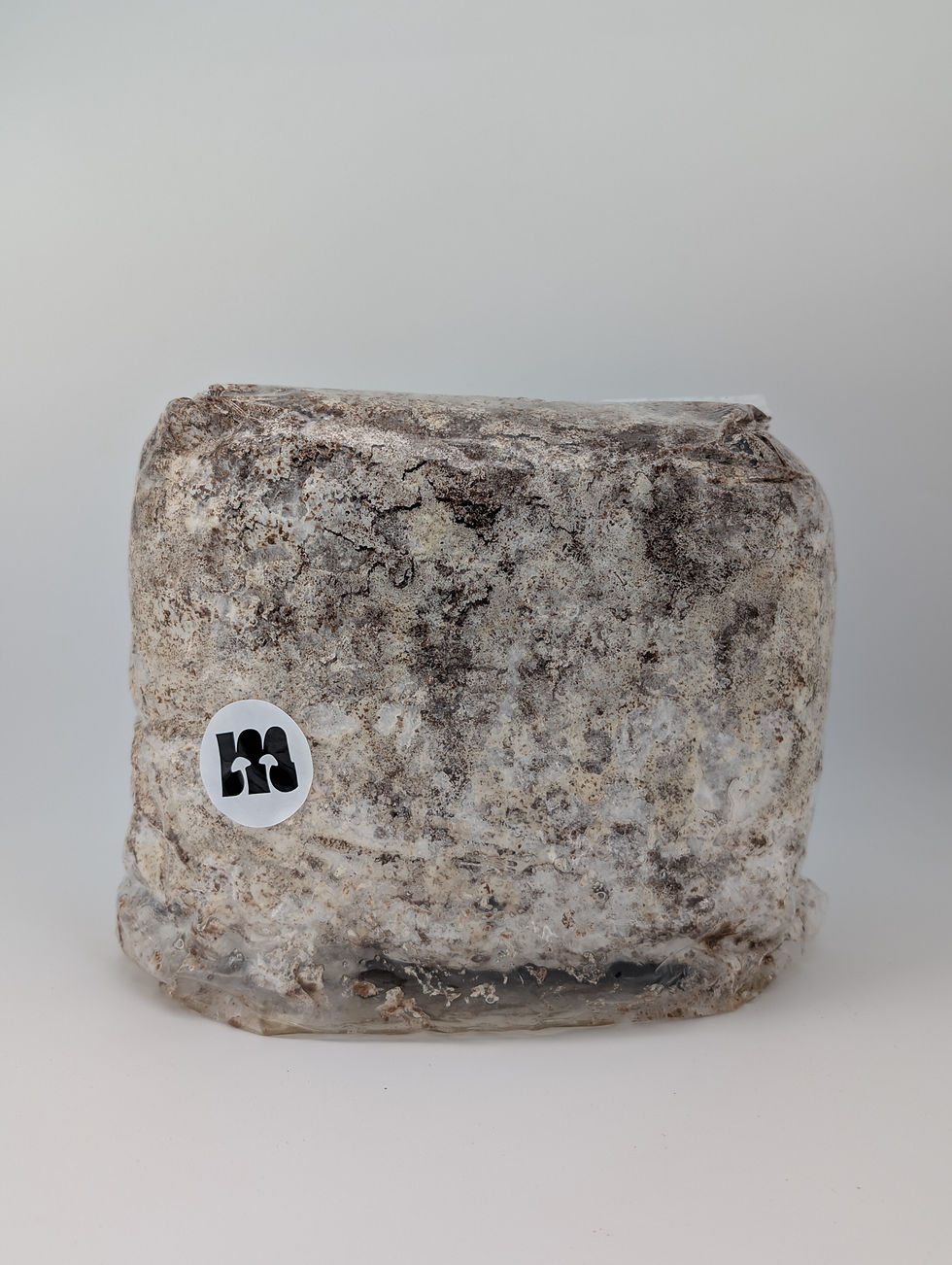
Grow kits: the easiest way in. A ready-to-fruit block that you just open, mist and harvest.
Happy hunting, and happy harvesting!
Source: Lee C-H, Lee Y-Y, Chang Y-C, Pon W-L, Lee S-P, Wali N, Nakazawa T, Honda Y, Shie J-J, Hsueh Y-P (2023). A carnivorous mushroom paralyzes and kills nematodes via a volatile ketone. Science Advances 9(3): eade4809.
Comments