
Why Old Oyster Mushroom Grow Kits Give Small Harvests – What Really Happens Inside the Bag

Updated: Oct 1
You open an oyster mushroom kit. The block is snow white, firm, looks perfect. You spray it, wait, and a small cluster appears at the edge of the cut. You harvest it, wait again, and another small cluster comes. Then another. The kit keeps fruiting, but every flush is tiny, and in the end the whole harvest is a fraction of what it should have been. Sometimes it is even worse: you get only one or two small flushes, and then the block starts turning green or smelling off as contamination takes over.
Most of the time the kit is not dead and nothing is wrong with it. It is simply too old. Maybe it waited too long in an incubation room or a warehouse before it was sold, or it sat in a kitchen for a few weeks after it arrived. We see this every season in our own production, and it is the reason we take production planning so seriously. The biology behind it is fascinating, so let's open the grow bag and look inside.
What a grow block really is
A grow block is a living organism packed in a bag. We mix oak sawdust with wheat bran, moisten it, sterilise it and inoculate it with oyster mushroom mycelium. Over the following weeks the mycelium, a network of microscopic threads called hyphae, grows through every gram of the substrate and turns it into one solid white block.
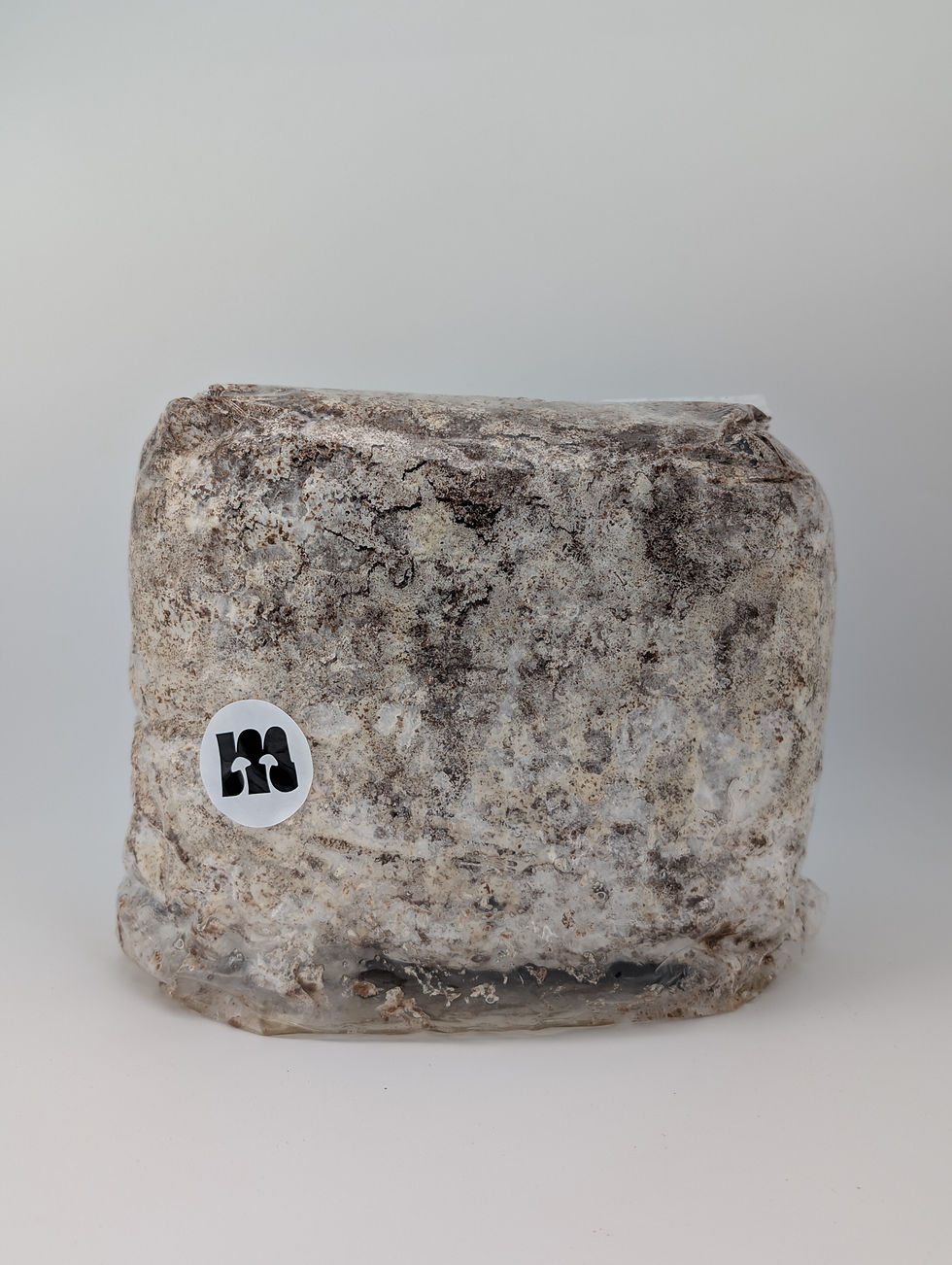
The bag itself is part of the system. Our grow bags have a filter patch with a pore size of 0.5 micrometres, about a hundred times thinner than a human hair. Mould spores, like those of green mould (Trichoderma), are several micrometres across and simply cannot pass, and most bacteria are held back as well. Gas molecules like oxygen and carbon dioxide are thousands of times smaller than those pores, so the block can still breathe. The filter lets the mycelium grow in a clean, protected space while it slowly exchanges air with the outside.
The sawdust is the long-term food: cellulose, hemicellulose and lignin, the tough polymers that make up wood. The bran is the fast food: starch, protein and nitrogen that the fungus can use right away. To get at the wood, oyster mushrooms release a whole toolkit of enzymes into the substrate, such as cellulases that cut cellulose into sugars and laccases and peroxidases that crack open lignin.
Here's the thing most people don't realise: the fungus is always burning something. Just like us, it breathes. It takes in oxygen, burns sugar and gives off carbon dioxide and water:
sugar + oxygen → carbon dioxide + water + energy
(or, for the chemistry fans: C₆H₁₂O₆ + 6 O₂ → 6 CO₂ + 6 H₂O)
The sugar comes from the substrate. The fungus's enzymes chop cellulose into glucose, the hyphae soak it up and burn it in their mitochondria, the same little power stations that run our own cells.
That reaction releases a surprising amount of energy: about 2,870 kilojoules for every 180 grams of glucose. To put that in perspective: 180 grams of glucose is roughly 45 sugar cubes, and 2,870 kJ is about 690 kcal, enough energy to bring around 8.5 litres of water from room temperature to the boil. Only part of it ends up as ATP, the energy the fungus uses to grow. The rest turns into heat. That's why a block gets warm while it colonises. At the peak of growth, the core of a block can be several degrees warmer than the room, and a shelf full of blocks packed tightly together heats itself up even more.
For us growers, that heat is a real challenge. If a block gets too hot, the mycelium gets stressed, and heat-loving competitors like green mould take their chance. So we keep our incubation room cool, give the blocks space so air can move between them, and keep an eye on the temperature. Once colonisation is done, things calm down and the block cools off, but it never stops breathing completely. Stamets calls this build-up of heat thermogenesis and warns that heat-tolerant contaminants which survived sterilisation wake up when the temperature inside the bags spirals upwards, which is why bags must be spaced apart during incubation (pp. 153, 173).
The equation also tells you where the weight goes. The carbon leaves as CO₂ gas, and some of the water escapes through the filter as vapour. A block that just sits there slowly gets lighter, without producing a single mushroom.
Every bit of sugar that leaves the block as CO₂ is sugar that will never become a mushroom. Keep that in mind; it'll come back later.
How a block decides to make mushrooms
A mushroom isn't the fungus itself. It's the fruit, a temporary structure the fungus builds only to spread its spores. Making it costs a lot of energy, so the fungus only does it when two things are true: it has eaten enough to afford it, and its surroundings tell it that it has reached open air.
Inside the bag, the fungus is in growth mode. It spreads, digests and stores reserves. When you cut the bag open, three things change at once: fresh air rushes in, light reaches the surface, and the air around the cut stays humid. At the surface, hyphae start growing into the air and tangle into tiny knots. Those knots are the first pins, the baby mushrooms.
So how does a fungus "smell" fresh air? Mainly through carbon dioxide. In the fungi scientists have studied closely, CO₂ drifts into the cell, where an enzyme called carbonic anhydrase turns it into bicarbonate. Bicarbonate switches on another enzyme that makes a messenger molecule called cAMP, and that messenger changes which genes are switched on (Mogensen et al., Elleuche & Pöggeler). Nobody has mapped every step of this in oyster mushrooms yet, but the result is plain to see in any grow room: lots of CO₂ keeps them growing, fresh air lets them fruit.
Scientists are also starting to understand the chemistry behind pinning. In one lab study on oyster mushrooms, hydrogen peroxide, a natural by-product of the cell's own respiration, rose sharply when the mycelium switched from growing to forming pins and sped the process up, while nitric oxide slowed it down. It's early research, but it suggests the switch to fruiting is linked to the fungus's energy metabolism.
Oysters fruit best at roughly 12–25 °C, 80–100 % humidity and CO₂ below about 1000 ppm. For comparison, outdoor air has around 420 ppm. A closed bag full of breathing mycelium has far more. The filter does let gas through, but only slowly, much slower than a whole block produces CO₂. That's exactly what we want during colonisation, and exactly why a kit won't fruit properly until you open it. In his classic handbook Growing Gourmet and Medicinal Mushrooms, Paul Stamets gives the numbers for the blue oyster: during colonisation it is happy at 5,000–20,000 ppm CO₂, but to form pins it needs less than 1,000 ppm, lots of fresh air and a cooler 10–15 °C. If CO₂ stays too high while the mushrooms grow, you get long stems and tiny caps; growers actually read the cap-to-stem ratio as a CO₂ gauge (p. 319).
What happens when a block waits too long
Now imagine the block is fully colonised, but nobody opens it. It sits in a warehouse, on a shelf, or in a kitchen cupboard "for later". The fungus has finished eating its way through the substrate, it is ready to fruit, but the signal never comes. So it does the only thing it can: it keeps growing.
With nowhere left to go inside the block, it grows on the surface, into the small air gap between substrate and plastic. Week after week that surface growth gets denser, until it forms a thick, white, felt-like or even leathery skin. Growers call it overlay. Often you will also see yellow to amber droplets sitting on it.

This isn't just our observation. In The Mushroom Cultivator, Paul Stamets and Jeff Chilton describe the same thing in button mushroom beds: overlay forms through prolonged vegetative growth, high CO₂, low humidity or too much heat. The mat becomes impervious to water and produces few pins, and the fix is to scratch it. They add that a crop with overlay rarely gives flushes as good as one managed properly (pp. 142–143, 228).
Three things make this skin a problem.
1. It repels water. Hyphae that grow into the air coat themselves in hydrophobins, tiny proteins that line up by themselves into a thin film wherever water meets air. One side sticks to the cell wall, the other side faces out and is water-repellent. It's a clever trick: it's what lets a fungus lift itself out of wet wood and into the air. But in a thick overlay it means the water you spray just beads up and rolls off, and the surface underneath dries out.
2. It's a wall. Pins form at the surface. A tough, dense mat is hard to push through, so pins show up late, in only a few places, and often just at the edge of a cut where the mat is thinner.
3. It has cost food. Remember the breathing equation? Every week the block waits, it keeps burning sugar and releasing it as CO₂. The easy food from the bran goes first, and part of what's left has gone into building the overlay instead of mushrooms. A study on stored oyster spawn found the same thing: the longer the spawn was stored, the lower the yield, both at room temperature and in the fridge. Cold slows the loss down, but it doesn't stop it. Stamets describes the same decline for stored spawn: as it ages, the food runs out, growth slows, metabolic waste builds up, the mycelium's defences fail and moulds and bacteria take over. By his estimate, spawn on day 60 can be only half as vital as on day 30 (Growing Gourmet and Medicinal Mushrooms, p. 153). That is exactly why an old kit so often gives one or two small flushes and then turns green.

Many small flushes instead of a few big ones. Put those three together and you get the typical old kit. It doesn't stop fruiting. It fruits again and again, but each flush is small. Pins only break through at the few spots where the skin is thin or damaged, so you get one little cluster instead of a big bouquet. And a block that has already burned part of its food can't support big mushrooms. Instead of two or three strong flushes, it spreads what's left over lots of weak ones.
Pins in the wrong place. Sometimes an older block doesn't wait for you at all and starts pinning inside the closed bag. Why? A block that has eaten its way through the substrate is running low on easy food, and for a fungus that is a signal in itself: when food gets scarce, it is time to reproduce. Add light shining through the clear plastic, a cool night or a few days in a cold room, and the thin air gap between substrate and plastic where hyphae can grow into open space, and the mycelium decides the moment has come. Tiny pins appear all over the inside of the bag.

The trouble is that under the plastic these pins have no fresh air and no room to grow. They stall, dry out or get squashed against the bag, and die. But the block doesn't know that. It sends water and nutrients to every single pin, just as it would to a real mushroom. Hundreds of little pins mean hundreds of little drains on the block's reserves, all at the same time and all for nothing. By the time you finally open the bag, part of its strength has already gone into mushrooms you will never harvest, so the ones that grow from your cut are fewer and smaller. And the dead pins don't just disappear. They start to rot, and that soft, dead tissue is an easy way in for green mould and bacteria. You can often see it in old bags: brown spots and green patches right where a crop of pins has died.

Paul Stamets describes exactly this in Growing Gourmet and Medicinal Mushrooms. Oyster mushrooms are strongly light-sensitive: even a brief exposure to light can trigger thousands of primordia, and blue light is the most stimulating (pp. 121, 215). Clear bags produce the most primordia, but they often form all over the bag, and oyster species regularly produce "volunteer" crops inside the bags while they are still incubating (pp. 178, 197). He also warns that when a block forms more primordia than its nutrition can support, the yield actually drops, and that aborted primordia become sites of contamination by moulds, bacteria and even flies. A good strain brings about 90% of its primordia to harvest (pp. 122, 319).
How to avoid it. Light is one of the strongest triggers. Oyster mycelium can sense light, and a block that is still colonising in a bright room gets the message "I've reached the surface" long before it should. It starts pinning everywhere under the plastic instead of finishing its job inside the bag. That's why our incubation room is kept dark and at a steady temperature, and why we move blocks into fruiting on time instead of letting them wait. At home the same rules apply: until you are ready to start your kit, keep it somewhere dark and at a steady room temperature, not on a sunny windowsill or in a spot where it gets cold draughts. And the best protection of all is simply not to wait. Once a block is evenly white, cut it open and give the pins a place to grow where they are actually useful.
And the droplets? Fungi "sweat" out liquid, a process called guttation. When scientists have analysed these droplets, they've found enzymes, sugars, organic acids and ammonia in them. On an oyster block, clear to amber droplets usually just mean the mycelium is active but a bit stressed. Cloudy, brown or smelly liquid is a different story. Stamets notes that aged oyster mycelium forms a thick, tough mat and secretes yellowish to orange droplets, and that oyster mushrooms release a metabolite that is toxic to nematodes: the mycelium stuns these tiny worms and then digests them as a source of nitrogen (pp. 315–320, citing Thorn & Barron 1984). Yes, oyster mushrooms are carnivores.
Not every oyster reacts the same way
All oysters can form an overl
ay, but some are much quicker to do it than others.
Oyster | How fast it forms overlay | What we notice |
Pink oyster (Pleurotus djamor) | Very fast | A tropical species with a short window. It also hates cold, so keeping it in the fridge is not an option. |
Golden oyster (P. citrinopileatus) | Fast | Dense white mat on top, few and scattered pins. We no longer grow it (see below). |
Phoenix oyster (P. pulmonarius) | Moderate to fast | A warmth-tolerant oyster that colonises quickly and is eager to pin. If it waits too long, it often starts forming pins inside the closed bag, which wastes energy. We only grow it in summer. |
Blue oyster (P. ostreatus) | Moderate | Thick white crust , often with yellow droplets. Pins mostly at the edge of the cut. |
King oyster (P. eryngii) | Fast, on the top surface | Fruits from the top of the block, where the mat forms first. |
How quickly a block reaches that point depends on the species. Stamets lists typical colonisation times of 7–10 days for pink oyster, 8–14 for phoenix oyster, 10–14 for golden oyster, 12–16 for king oyster and 12–21 for blue oyster (pp. 289–325). The faster a species colonises, the sooner its block is ready, and the shorter its window.
A note on the golden oyster: it is beautiful, fast and productive, and we enjoyed growing it. But research from North America shows it has escaped cultivation, is spreading through forests and is linked to a clear loss of native fungal diversity in the dead wood it colonises. Out of precaution we have stopped growing and selling it. You can read the full story in our article Golden Oyster Mushrooms: Why We Stopped Growing Them at Meisterpilze.
Big mushroom farms know this problem very well. In Japan, where many mushrooms are grown in bottles, growers routinely scrape away the old mycelium on top of each bottle before fruiting. They call it kinkaki, and it makes the pins come up fast and all at once. For king oysters, one patent even describes removing a layer about 1 cm deep. The funny part: oysters actually need their surface growth to fruit at all. When scientists switched off one of their wood-digesting enzymes, the mushrooms couldn't form aerial mycelium or pins. So the same surface growth that makes fruiting possible becomes a problem once it goes on for too long.
A kit on your kitchen table has no farmer scraping it at the perfect moment, which is why its age matters so much more.
What we see in our own production
We have not run formal trials on this, but we grow oyster blocks all year round, and the pattern is always the same:
Blocks that go to fruiting soon after they are fully colonised pin fast, evenly, and give the best first flush.
Blocks that wait longer grow a white skin and pin later and in fewer spots. They often keep fruiting for a long time, but in many small flushes, and the total harvest is noticeably lower.
Blocks opened too early, before the mycelium has taken over the whole substrate, are the ones that catch green mould. The unclaimed bran is an open buffet for competitors like Trichoderma.
So there is a window. For oysters (and lion's mane too), it is roughly 10 to 25 days after inoculation. Too early means contamination risk, too late means lower yields. Timing is everything, and that is why we pay so much attention to when a block goes into fruiting. On a mushroom farm, it matters even more than at home. Growing mushrooms is a business with small profit margins: substrate, spawn, energy, climate control and labour cost the same whether a block gives a big flush or a small one. So even 10% less yield from blocks that fruit too late can eat up a large part of the profit. For us, fruiting every block at the right moment is not a detail. It decides whether a batch pays off.
How to rescue an oyster kit with a crust
If your kit already has a thick white skin, don't give up on it:
Make a U-shaped or X-shaped cut in the side of the bag, about 15 cm long. The opening lets fresh air in while keeping the humidity high right where the pins should form. If the room is dry, make it smaller, 7 to 10 cm at most. In winter, the heating can push the humidity in a kitchen below 40%. A smaller cut means the block loses less moisture, and the air between the block and the plastic stays more humid, which is exactly what the pins need. If your bag is a bit older and the mycelium has become denser, look for the spot where it is thinnest and least dense and make your cut there: that is where the pins will break through most easily.
Scratch the surface inside the cut lightly with a clean fork. This breaks the water-repellent skin and exposes fresh, young mycelium, the same idea as kinkaki on the farms. But don't overdo it, and make sure the fork is really clean. The mycelium is the block's protective layer, a bit like our skin: a light scratch heals quickly, but if you scrape it away down to the bare substrate, that spot becomes a weak point where mould and bacteria can get in.
Spray the cut with water and keep the kit in indirect light, away from heaters and direct sun.
King oyster is different. It fruits from the top of the block, not from the side. Open the top of the bag instead of making a U-cut, and scratch the top surface with a clean fork if it has formed a mat. Our favourite method at Meisterpilze: if the block is a bit older and has formed that thick mycelium layer on top, we first scratch it a little with our fingers, pressing through the plastic without opening the bag. A fresh block doesn't need this step. Then we make a small cut at the top so more oxygen can get in, and put the block somewhere cold, a fridge for example. The cold wakes the block up, and after 4 or 5 days you will see pins forming. That is the moment to move the block into fruiting conditions, such as a fruiting tent. This fits well with what Paul Stamets describes in Growing Gourmet and Medicinal Mushrooms. For king oyster, he gives 10–15 °C, 95–100% humidity and low CO₂ (500–1,000 ppm) for pins to form, and says this stage takes 4–5 days, just like we see. A fridge is a bit colder than that, but it gives the block a clear signal. After that, the young mushrooms grow best at 15–21 °C and 85–90% humidity for another 4–8 days. His own best harvests came from bags cut open horizontally at the top, leaving a plastic wall of about 8–10 cm standing around and above the surface. That wall protects the very sensitive young mycelium from drying out and keeps the air humid right where the pins form (pp. 307–308).
A rescued kit will usually fruit again. It rarely matches the harvest of a kit started on time, because part of the food is already gone.
Why a fresh kit makes all the difference
If you take one thing from all this biology, let it be this: an oyster kit is not a product that waits for you, it is a living thing on a clock. A kit that spent weeks in a warehouse or on a supermarket shelf may still look white and healthy, but it has already used up part of its best moment.

When you buy a kit, look for:
A grower, not a reseller. Someone who makes the blocks themselves knows how old they are.
A clean, evenly white block. No green patches, no thick yellowish crust.
Honest information on the bag: a good block carries its inoculation date. Oyster and lion's mane blocks should go into fruiting about 10 to 25 days after that date.
And once it arrives: start it right away, don't save it for later.
You may notice that our grow blocks don't come in a fancy printed box. That is a conscious choice. In a clear bag you can see exactly what is going on with your block: how white it is, whether it is starting to form pins, and whether anything looks off. A nice box looks great on a shelf, but it also hides the block inside. Now and then, a boxed kit turns out to be older than expected when it is finally opened. It may already have pins forming all over the block, which uses up energy that would otherwise go into the harvest, or it may have a contamination nobody could see. That is not the rule, and we are not perfect either: every grower makes mistakes sometimes, us included. We just prefer that you can see your block, and that you can tell us if something isn't right.
At Meisterpilze we grow every block ourselves, from mixing the oak sawdust and wheat bran to the finished kit, and we plan our production around this window. We keep a close eye on our production plan and inventory, so that blocks don't sit too long in the incubation room. If we see that a block is passing its prime, we don't send it out as a kit anymore; we fruit it here ourselves.
When a block has a long journey ahead, for example to another EU country, we send it before it is fully colonised. The mycelium keeps growing inside the closed bag while it travels, protected by the filter, and finishes colonising on the way. That way the days in transit are not lost from the fruiting window: the block arrives close to its prime instead of already past it. Finishing colonisation inside the sealed bag is safe; the risk only comes from opening a block too early. So if your block still has a few darker, uncolonised patches when it arrives, just wait a few days until it is evenly white before you cut it open.
This matters even more because most people don't start their kit the moment it arrives. It often waits a few days, sometimes weeks, on the kitchen table. A kit that leaves us at its best has room for that; a kit that was already old when it was shipped does not. Every kit comes with all the information you need to get it fruiting. And if your mushrooms still don't grow, we simply send you a new grow block. We ship in paper packaging across Germany and the EU.
The mushrooms you harvest are the last chapter of a story that started weeks before in our farm. The fresher the kit, the better that chapter will be.
Frequently asked questions
Why is my oyster mushroom grow kit not fruiting?
The most common reason is that the block is too old. When a fully colonised block stays closed too long, the mycelium keeps growing on the surface and forms a thick, water-repellent skin that makes it hard for pins to form. Another possible reason is contamination: green, grey or black patches, a slimy surface or a sour smell mean moulds or bacteria are competing with the mycelium, and a contaminated block often stops fruiting altogether. Too little fresh air, low humidity, or temperatures outside the species' range can also hold a kit back.
Why does my grow kit only give small flushes?
An old block often keeps fruiting, but in many small flushes. Pins can only break through where the surface skin is thin, and part of the block's food has already been burned during storage, so there is less energy for each flush. Sometimes an old block has also started pinning inside the closed bag, and those stalled pins have used up energy too.
What is the thick white layer on my grow block?
It is called overlay: dense vegetative mycelium that grows on the surface when a block waits too long before fruiting. It is not mould and not dangerous, but it lowers the yield.
What are the yellow droplets on my oyster grow kit?
They are exudate, liquid the mycelium releases while it grows, containing water, enzymes, sugars and organic acids. Clear to amber droplets are normal, often a sign of a stressed but healthy block. Cloudy, brown or foul-smelling liquid can point to contamination.
Can I save an old oyster grow kit?
Usually yes. Make a U-shaped or X-shaped cut of about 15 cm in the side of the bag (7 to 10 cm if the room is dry), scratch the surface inside the cut lightly with a clean fork, and spray it with water. For king oysters, open the top of the bag and scratch the top surface instead. A rescued kit fruits again, but normally gives less than a fresh one.
How long can I wait before starting my grow kit?
As short as possible. Oyster and lion's mane blocks should go into fruiting about 10 to 25 days after their inoculation date. Start your kit as soon as it arrives and is evenly white.
Can I store a grow kit in the fridge?
Cold slows the block's respiration and ageing, but does not stop it. Blue oysters tolerate short cool storage. Pink oysters are tropical and are damaged by cold, so never put them in the fridge.
Why does my grow block feel warm?
The mycelium breathes: it burns sugars from the substrate and releases CO₂, water and heat. During active colonisation a block can be several degrees warmer than the room.
A block that feels clearly warm or even hot is not a good sign, though, especially once it is fully colonised and should be calming down. Very often it means contamination. Bacteria and moulds such as Trichoderma grow and breathe much faster than oyster mycelium when they get access to the nutrient-rich bran, so they release far more heat. That heat then feeds itself: most competitors love warmth, while oyster mycelium gets stressed by it, so the warmer the block gets, the faster the contamination wins. If your block is hot, smells sour or shows green, grey or slimy patches, it is best not to open it indoors.
Why do grow bags have a filter?
Our bags have a 0.5 µm filter. Mould spores and most bacteria are too large to pass, while oxygen and CO₂ can still move through slowly. This protects the block during colonisation and keeps CO₂ high, which is also why the kit only fruits properly once it is opened.
Can I open my grow kit before it is fully colonised?
Better not. Uncolonised substrate is easily taken over by moulds like Trichoderma once it is exposed to air. If your block still has darker patches when it arrives, wait a few days in the closed bag until it is evenly white. Occasionally, part of a block never colonises. If you still want to fruit it, make the cut as far away as possible from the uncolonised part.
Why doesn't Meisterpilze sell golden oyster kits?
Golden oyster has escaped cultivation in North America and is linked to a loss of native fungal diversity in forests. It has also been reported growing wild in Europe. We don't want to contribute to the same thing happening in European forests. As mushroom farmers, we believe it is our responsibility not only to grow good mushrooms, but also to avoid causing environmental problems. So, out of precaution, we stopped growing and selling it. Read the full article.
Further reading
Identification and expression analysis of Pofst3 during Pleurotus ostreatus primordia formation. Fungal Biology.
Mogensen E.G. et al. (2006). Cryptococcus neoformans senses CO₂ through the carbonic anhydrase Can2 and the adenylyl cyclase Cac1. Eukaryotic Cell.
Elleuche S., Pöggeler S. (2009). β-Carbonic anhydrases play a role in fruiting body development in Sordaria macrospora. PLoS ONE.
Nitric oxide negatively regulates the rapid formation of Pleurotus ostreatus primordia (2022). Journal of Fungi.
Induction of fruiting in oyster mushroom by polymeric 3-alkylpyridinium salts, citing Chang & Miles (1989).
Wösten H.A.B. et al. (1999). How a fungus escapes the water to grow into the air. Current Biology.
Utrecht University. Fungal hydrophobins.
Effect of spawn storage conditions on the sporophore production of Pleurotus sapidus.
Fungal exudates (1978). Canadian Journal of Microbiology.
Fungal guttation, a source of bioactive compounds, and its ecological role (2021). Biomolecules.
Technology of mushroom cultivation. Vietnam Journal of Science and Technology.
Choi U.-K., Lee O.-H., Kim Y.-C. (2011). Effect of calcinated oyster shell powder on king oyster mushroom. Molecules.
Silencing of the laccase (lacc2) gene from Pleurotus ostreatus (2023). Journal of Fungi.
Stamets P. (2000). Growing Gourmet and Medicinal Mushrooms, 3rd ed. Ten Speed Press.
Stamets P., Chilton J.S. (1983). The Mushroom Cultivator. Agarikon Press.


Comments